In the lab, almost everything starts with the balance. That's why, when it comes time to buy one, the usual question arises: do I need an analytical balance or is a precision balance enough?
The answer doesn't depend on which is "better," but rather on what you're going to weigh. We'll tell you how they differ, what questions you should ask yourself before choosing, and how the OHAUS Adventurer AX series fits into each scenario.
The difference lies in the decimal places.
What separates an analytical balance from a precision balance is readability : the smallest weight change the balance can display. The more decimal places, the finer the measurement, but the lower the maximum capacity usually is.
| Guy | Standard readability | Usual capacity | What is it used for? |
|---|---|---|---|
| Semi-micro | 0.01 mg (5 decimal places in grams) | Up to about 100–200 g | Very small quantities: patterns, small samples, trace analysis |
| Analytics | 0.1 mg (4 decimal places) | Up to about 300g | Preparation of solutions, reagents, and samples for analysis |
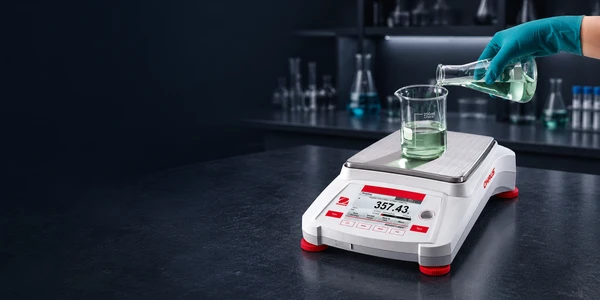
| Precision | From 1 mg to 0.1 g (3 to 1 decimal places) | From hundreds of grams to several kilograms | Culture media, buffers, formulations, product control |
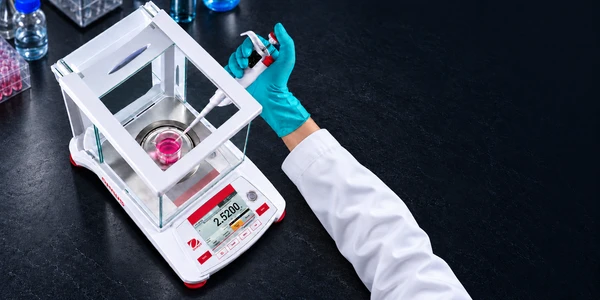
Analytical and semi-micro microscopes use air shields , a glass enclosure that protects the dish. At that level of detail, even a simple draft or breathing can alter the reading. 1 mg precision microscopes also typically have them; those with 0.01 g or 0.1 g resolution have a larger, more open dish, designed for larger containers.
The ranges in the table are for guidance only: each manufacturer groups its models in its own way.
How to choose: six questions before buying
- 1
What is the smallest amount you are going to weigh?
This is the most important question. A scale doesn't reliably weigh any amount displayed on the screen: below its minimum weight , the relative error skyrockets. If you're weighing just a few milligrams, you need an analytical or semi-micro scale. - 2
And the largest one, including the container?
The maximum capacity includes the beaker, flask, or plate. A heavy container can leave you with no margin for error in a blood test. - 3
Where will it be?
Air currents, vibrations, and temperature changes have a greater impact the more decimal places the balance has. Analytical work requires a stable table and should be done away from doors, windows, and fume hoods. - 4
Do you work with GLP/GMP or do you need traceability?
Then you're interested in a scale that manages users, records date, time and sample identification, and allows data export. - 5
Who calibrates it and how often?
With automatic internal calibration, the scale adjusts itself. With external calibration, it is done by a person using a standard weight. - 6
Do you need legal metrology?
If the results have commercial or legal implications, you may need an approved and verified template.
The same series for all three cases: OHAUS Adventurer AX
The OHAUS Adventurer AX series includes semi-micro, analytical, and precision balances with the same display and operation. This allows you to choose the readability you need without requiring the equipment to learn how to use a different balance.
| Guy | Models | Maximum capacity | Readability |
|---|---|---|---|
| Semi-micro | AX85, AX125D, AX225D | 82 g 220 g | Up to 0.01 mg |
| Analytics | AX124, AX224, AX324 | 120 g 320 g | 0.1 mg |
| Precision | AX223, AX423, AX523, AX623 | 220 g 620 g | 1 mg |
| Precision | AX422, AX822, AX1502, AX2202, AX4202, AX5202, AX6202 | 420 g 6.2 kg | 0.01 g |
| Precision | AX2201, AX4201, AX8201, AX12001 | 2.2 kg to 12 kg | 0.1 g |
Models ending in /E have only external calibration; the rest also include automatic internal calibration AutoCal™ . Those ending in M are models approved for legal metrology (OIML R76).
What they all have in common:
✓ Color touchscreen that works with gloves. Plus, six physical keys for tare, zero, calibration, and printing.
✓ Integrated application modes. Parts counting, percentage weighing, control and dynamic weighing, formulation, density and totalization, among others.
✓ Three-level user management. One administrator, two supervisors, and ten users, with GLP data logging and real-time clock.
✓ Minimum weight warning. The screen indicates when the sample is below the defined limit.
✓ Connectivity. Front USB for transferring data to a memory stick, rear USB for connecting to a computer, and RS232. The configuration can be cloned to other Adventurer models using a USB memory stick.
✓ Compact draft excluder in models from 0.01 mg to 1 mg, with two-panel doors that take up less space when open.
Adventurer Promotion
20% discount on the entire Adventurer AX series
If you were thinking of upgrading your scale, now you have the complete range, from semi-micro to precision, with a 20% discount. Offer valid until the end of the year.
View models on saleFrequently Asked Questions
What is the difference between an analytical balance and a precision balance?
Readability. An analytical scale typically displays down to 0.1 mg and weighs at most a few hundred grams. A precision scale displays from 1 mg to 0.1 g, but can handle much larger loads.
What is the readability of a scale?
This is the smallest weight change the scale can display. It is not the same as the minimum weight it can reliably measure, which is always higher.
What is the minimum weight?
The smallest quantity the scale can weigh with the accuracy your method requires. Below that, the relative error is too large. Adventurer scales display an on-screen alert when a sample falls below the defined minimum weight.
What advantage does internal calibration offer?
The scale automatically adjusts itself using an internal weight, without requiring manual adjustment. In the Adventurer AX series, all models except the /E, which are calibrated with an external weight, feature this system.
What does the M mean in Adventurer models?
These are models approved for legal metrology according to OIML R76. They are the ones indicated when the weighing result has commercial or legal effects.
OHAUS scales with Proquinorte
Are you torn between two models or unsure about the level of readability you need? Tell us your weight and the conditions under which you measure, and we'll help you choose the Adventurer that's right for your lab.
Talk to our team